
No subtitles for this video yet.
The Science of Textile Dyeing - How Dye Molecules Bond With Fabric

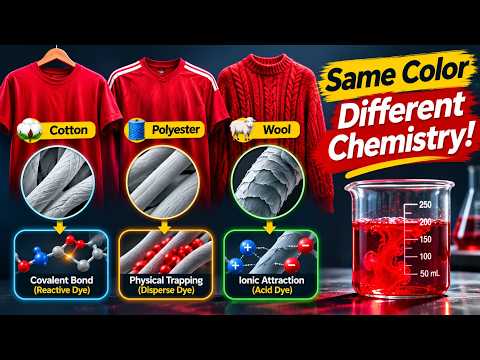
DescriptionA cotton T-shirt, a polyester sports jersey and a wool sweater can all be exactly the same shade of red and keep that color wash after wash. But inside the fibers, each red is held in place by completely different chemistry. In this Textile Vlog video we shrink down to the molecule and explain how textile dyeing reallMore
A cotton T-shirt, a polyester sports jersey and a wool sweater can all be exactly the same shade of red and keep that color wash after wash. But inside the fibers, each red is held in place by completely different chemistry.
In this Textile Vlog video we shrink down to the molecule and explain how textile dyeing really works:
• Chromophores: why a dye molecule has color at all
• Dye vs pigment: inside the fiber vs glued on with a binder
• The 6-step dyeing journey: dissolve → transport → adsorption → diffusion → fixation → wash-off
• Amorphous vs crystalline regions: where dye can enter a fiber
• The 5 forces that hold dye: covalent bonds, ionic attraction, H-bonds and van der Waals forces, hydrophobic attraction, and physical trapping
• Cotton dyes: reactive (salt, alkali, hydrolysis), direct, vat and sulphur
• Wool, silk and nylon: acid dyes and ionic attraction
• Acrylic: basic (cationic) dyes and the glass transition temperature
• Polyester: disperse dyes at about 130 °C
• More classes: azoic, mordant, metal-complex and pigment coloration
• In the factory: jet, package, pad-steam and thermosol dyeing; reduction clearing; fastness testing
• The future: waterless supercritical CO₂ dyeing, digital color control and salt-free cotton dyeing
Watch next: The Science of Indigo Dyeing
CHAPTERS
0:00 Same red, three chemistries
0:19 Inside the dye molecule
0:54 How dyeing works
1:53 Cotton dyes: reactive, direct, vat, sulphur
3:07 Wool, silk, nylon & acrylic
3:32 Polyester & disp
- Loading…